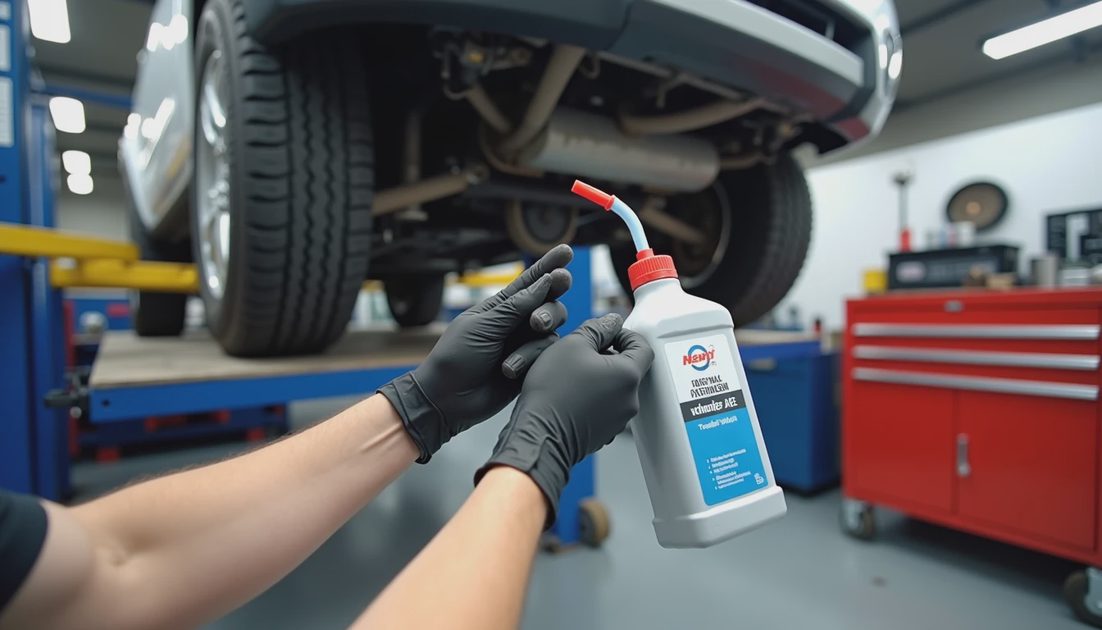
Using the right transfer case fluid prevents noisy 4WD, overheating, and drivetrain damage
Why This Matters (cost/safety/longevity payoff)
Your transfer case is the gearbox that splits power to the front and rear axles in a four-wheel drive (4WD) or all-wheel drive (AWD) vehicle. It lives a hard life: constant gear motion, heat, and sometimes internal clutches (friction packs that engage and release to manage torque).
Putting the wrong fluid in the transfer case is one of those “it still drove fine… until it didn’t” mistakes. The wrong lubricant can cause clutch slip (clutches can’t hold), overheating (fluid can’t manage friction/heat), and seal damage (rubber seals degrade and leak). All three can turn into expensive drivetrain repairs.
Let’s start with the basics and build from there: what fluid transfer cases typically use, why they use it, and how to confirm the exact specification for your vehicle so you don’t have to guess.
What You Need to Know (specs, types, intervals)
The big rule
Most transfer cases use gear oil, not automatic transmission fluid (ATF)—but some models do require ATF or a manufacturer-specific fluid. You must verify what your transfer case calls for.
Common transfer case fluid types (from the source)
1. Gear oil:
- Typical viscosities: SAE 75W-90 or SAE 80W-90
- Often synthetic (man-made base oil formulated for stability and longevity)
- Often needs an API GL-4 or GL-5 rating (a performance category for gear lubricants; your manual will specify which is appropriate)
2. Synthetic gear oil variants:
- Example viscosity: 75W-140
- Sometimes used for heavy-use or extreme-temperature conditions (only if specified)
3. ATF (Automatic Transmission Fluid):
- Some transfer cases—especially older or certain models—specify ATF instead of gear oil
- Examples listed in the source: Dexron II/III, Dexron VI, or MERCON
- Warning: Do not use ATF unless your manual specifies it
4. Manufacturer-specific fluids:
- Some OEMs require a unique transfer case fluid specification (specific viscosity or branded synthetic)
- You must match the exact spec shown in the owner’s manual or on the transfer case label/tag
Quick Quiz (knowledge check)
1) True or false: “If it’s a drivetrain lubricant, ATF is close enough to gear oil.”
2) Which viscosities are listed as the most common for transfer cases: 75W-90, 80W-90, or 0W-20?
3) Where are the two best places to confirm the exact spec?
(Answers: 1) False. 2) 75W-90 or 80W-90. 3) Owner’s/service manual and the transfer case label/tag or fill plug stamping.)
How It Works (what the fluid does + how to pick the right one)
System Diagram (mental model)
Engine → Transmission → Transfer case → Front driveshaft + Rear driveshaft
Inside the transfer case, you may have:
- Gear sets (to change direction/speed of rotation)
- A chain drive (common on many modern light-duty cases)
- In some designs, internal clutches (friction elements that engage to manage power distribution)
Why the correct fluid matters
Transfer case fluid has three jobs:
1. Lubrication: keeps metal parts from grinding together
2. Cooling: carries heat away from gears/chains/clutches
3. Protection: helps prevent wear and supports seals
Gear oil and ATF are not interchangeable by default:
- Gear oil (like SAE 75W-90 or 80W-90) is designed for high-load gear contact and often comes with GL-4 or GL-5 performance requirements.
- ATF (like Dexron II/III, Dexron VI, or MERCON) is a different formulation intended for automatic transmissions; only use it in a transfer case if the manufacturer explicitly calls for it.
How to determine the exact fluid for your vehicle (no guessing)
Follow this sequence:
1. Check the owner’s manual or service manual
Look in the transfer case section. It should list the required fluid type and viscosity (for example: SAE 75W-90 gear oil, GL-4/GL-5, or ATF Dexron VI).
2. Inspect the transfer case label/tag or fill plug stamping
Many transfer cases have a tag or marking that lists the correct specification.
3. Contact the manufacturer or dealership with your VIN
VIN (Vehicle Identification Number) lookup removes ambiguity when manuals are missing or when there were mid-year changes.
4. Use OEM-approved lubricants from reputable brands
The key is matching the required specification so the fluid is compatible.
Pro Tip: If the manual and the tag disagree, stop and verify using a service manual or dealership VIN check before adding fluid. Mixing the wrong type can lead to overheating, clutch slip, or seal damage.
Common Mistakes (myths, pitfalls, warnings)
Mistake 1: Assuming “most transfer cases use ATF”
The source is clear: in most vehicles, the transfer case is lubricated with gear oil, often SAE 75W-90 or 80W-90, frequently synthetic. ATF is only for a minority of cases.
Mistake 2: Ignoring the GL rating
If your manufacturer calls for API GL-4 or GL-5, treat that as part of the spec—not an optional suggestion. Using the wrong rating can reduce protection where gears and chains need it.
Mistake 3: Choosing a thicker fluid “for protection” without approval
The source mentions 75W-140 as a synthetic gear oil variant used in some heavy-use or extreme-temperature situations. That does *not* mean it’s safe for every transfer case. Always follow the manufacturer’s required viscosity.
Mistake 4: “Any synthetic is fine”
Synthetic is often preferred, but manufacturer-specific fluids exist for a reason. If the transfer case calls for a specific OEM fluid spec, match it exactly.
Mistake 5: Missing the early warning signs
Don’t wait for a hard failure. The source lists symptoms that should trigger a check:
- Unusual noises when engaging 4WD
- Grinding sounds
- Difficulty shifting into gear
If you notice these, have the fluid condition and level inspected.
Bottom Line (summary, recommended action)
Most transfer cases use gear oil—typically SAE 75W-90 or 80W-90, often synthetic, and commonly requiring API GL-4 or GL-5. But some models require ATF (such as Dexron II/III, Dexron VI, or MERCON) or a manufacturer-specific fluid.
Your action plan is simple: confirm the exact transfer case fluid specification using the owner’s/service manual, the transfer case label/tag or fill plug stamping, or a VIN-based dealership check. That one verification step is what keeps your 4WD/AWD system quiet, cool, and reliable.


No letters yet — be the first to write.