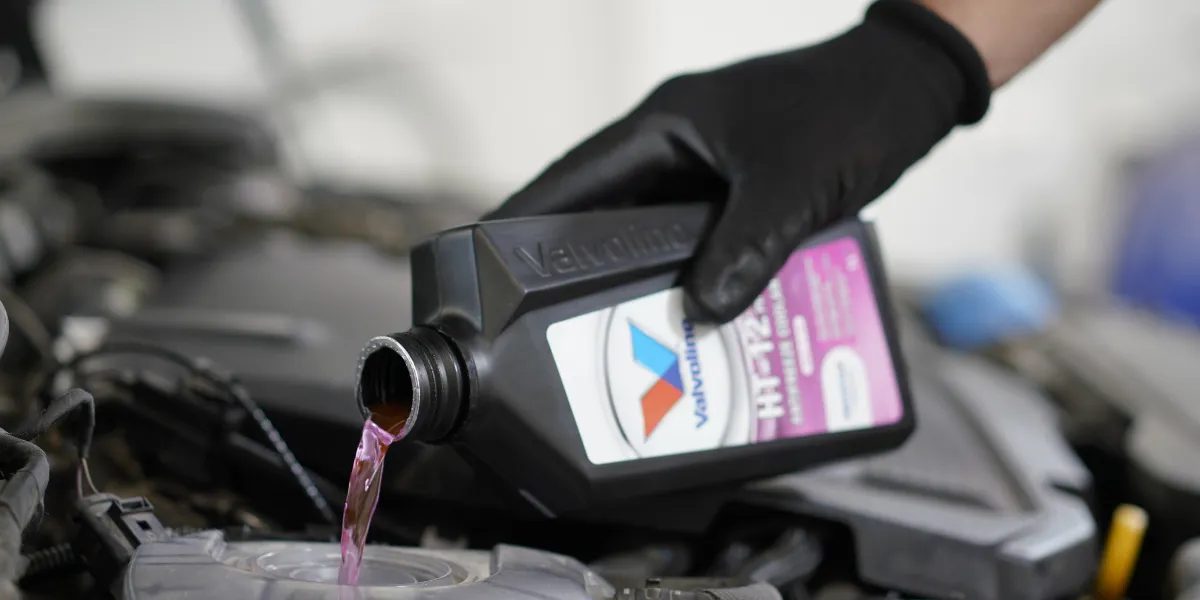
Among the most critical fluids in both internal combustion engines and new-energy vehicles, coolant stands out as an indispensable component.
At its core, coolant is a fluid formulation composed of ethylene glycol, water, and a suite of performance-enhancing additives.
The significance of these fluids and their functions within the cooling system has been covered previously. To summarize, coolant serves multiple purposes simultaneously. Its chief function is dissipating the excess heat that engine operation generates. At low temperatures, it depresses the freezing point of the cooling system, while in summer conditions it elevates the boiling point. Beyond thermal management, coolant also minimizes friction between metal components, delivers essential lubrication, and flushes contaminants out of the engine.
Prior to the mid-1990s, a single standardized coolant formula served all vehicles — the widely recognized green or blue fluid.
From that point forward, coolant technology has advanced at a remarkable pace, driven by the demands of high-performance engines, extended service intervals, and increasingly stringent emissions standards.
This comprehensive guide examines the coolant formulations found in modern automotive engines.
The majority of vehicles produced during the 20th century continue to rely on IAT (Inorganic Additive Technology) coolants. These green or blue fluids remain widespread across Europe, particularly throughout its eastern and southeastern regions.
Mineral inhibitors form the basis of these formulations — silicates, phosphates, borates, nitrites, and related compounds. These inorganic additives build a protective barrier that separates metal components from direct contact with the cooling fluid. As a consequence, they tend to offer shorter service lives and call for more frequent maintenance and replacement. Typical service intervals fall between two and three years, or roughly 48,000 km to 72,000 km, depending on the specific additive package employed.
Nevertheless, engine technology has progressed considerably, producing powerplants that are both more powerful and more efficient. These advances demand cooling capabilities that IAT technology is simply unable to deliver.
Inorganic coolants perform best when paired with the metals characteristic of older engines — steel, copper, iron, and brass.
In response to the limitations inherent in Inorganic Additive Technology, coolant developers have introduced more sophisticated cooling solutions.
This effort gave rise to organic coolants — fluids engineered expressly for contemporary engines built with aluminum components.
Organic Acid Technology, commonly referred to as OAT coolants, was originally developed to address the shortcomings associated with IAT coolants.
True to their name, these formulations rely on organic acids and exclude silicones and nitrites entirely. Their corrosion inhibition depends solely on organic compounds, primarily carboxylates and triazole.
These are non-depleting corrosion inhibitors that give OAT coolants their extended service capability. Essentially, as the engine reaches operating temperature, these compounds degrade far more slowly than inorganic acids, maintaining effective corrosion protection throughout their service life.
Industry experts indicate that OAT coolants can remain effective for as long as five years or 240,000 km — a characteristic that has earned them the designation of long-life or fill-for-life coolants.
OAT coolants most commonly appear in orange, though the actual color varies by manufacturer and may also be yellow, pink, red, violet, or dark green.
Organic Acid Technology is compatible with a broad spectrum of newer vehicles, including models from Volkswagen, Audi, Saab, General Motors, and Honda. That said, these formulations provide insufficient protection for copper and brass components, which means they are unsuitable for use in older vehicle designs.
Each of these technologies — IAT and OAT — carries its own strengths and weaknesses. IAT offers robust anti-corrosion performance but falls short on longevity, while OAT can outlast IAT by a factor of two or three yet provides comparatively weaker corrosion protection.
By combining IAT and OAT technologies, lubricant manufacturers have created coolant formulas that achieve both long service life and superior corrosion resistance.
This hybrid approach gives vehicle owners the advantages of both technologies. The most prevalent hybrid coolant categories are outlined below.
Hybrid OAT (HOAT) coolants are blended from Organic Acid Technologies (OAT) and IAT inhibitors, notably silicates. The inclusion of silicates provides dedicated protection for aluminum engines and cooling system components.
Numerous American and European automakers specify hybrid OAT technologies for their production vehicles.
These formulations deliver notably long service intervals, with service lives reaching up to 10 years or 290,000 km.
HOAT coolants are most frequently yellow, though they may also appear in orange, violet, or pink.
Nitrite OAT combines Organic Acid Technology with nitrite inhibitors, making it well suited for heavy-duty applications and diesel-powered engines.
The operational lifespan of NOAT coolants extends to 12,000 engine hours or 965,000 km, and they are characterized by a distinctly red or orange color.
However, incorporating nitrites as additives introduces a range of complications. These compounds interact with the flux used in joining aluminum components, a reaction that alters the coolant's acidity and heightens the risk of metal corrosion. Additionally, this process leads to the formation and accumulation of undissolved solids capable of clogging filters, coating heat exchangers, or depositing on cylinder liners. Such build-up can impair heat dissipation and trigger fuel pre-ignition.
Phosphated HOAT pairs organic acid technology with phosphate inhibitors to resist rust and corrosion throughout the engine.
Asian automotive manufacturers — including Toyota, Hyundai, Nissan, KIA, Honda, and Subaru — frequently specify this coolant type.
P-HOAT is typically found in pink or blue.
Phosphated HOAT coolants generally carry a service life of five years or 240,000 km.
This coolant type is especially important across much of Europe, where hard water presents a recurring challenge. Calcium and magnesium — minerals prevalent in hard water — interact with phosphate inhibitors to produce calcium/magnesium phosphate, which can create scale deposits on engine surfaces. For this reason, phosphate-free HOAT coolants are the preferred choice in such environments.
NAP-free (phosphate-free) HOAT coolants are grounded in Organic Acid Technology and are formulated without nitrites, amines, phosphates, or silicates. This absence of those compounds makes NAP-free technology a frequent choice for heavy-duty vehicle applications.
Service life for these coolants reaches 10 years or 1,600,000 km. BMW, Tesla, Volvo, and Mini Cooper are among the manufacturers that specifically call for NAP-free coolants.
NAP-free HOAT coolants are generally turquoise, though the exact shade varies by manufacturer. Valvoline OEM Advanced 48 Coolant is a notable example — a low-silicate, phosphate-free formulation developed specifically to minimize corrosion across all cooling system metals.
Si-OAT coolants integrate Organic Acid Inhibitor technology with silicates — an IAT inhibitor — placing them among the most recently developed and most potent coolant formulations currently available.
This coolant type contains no amines, nitrites, phosphates, or borates.
In contrast to other formulas incorporating inorganic additive technology, Si-OAT coolants demonstrate excellent hard water stability and exhibit low depletion rates.
They are also fully compatible with other ethylene glycol-based coolants and may be safely blended with them.
Service life extends to five years or 240,000 km.
Si-OAT coolants offer extended operational life and satisfy the requirements of the most recent European-manufactured vehicle engines, including those from Audi, Volkswagen, Mercedes-Benz, and Porsche.
Pink or violet is the most typical color associated with Si-OAT coolants.
Additional information on the advantages and applications of Si-OAT technology is available below.
For over 150 years, Valvoline has been reshaping the landscape of lubricant technology. The company continuously refines and innovates its product lineup to address the escalating requirements of contemporary engines, with proprietary engine test technologies driving consumer-focused advancements and top-tier performance solutions.
A prime illustration of this commitment is the HT-12 coolant line, which represents a breakthrough development in the engine coolant field.
In the second half of 2021, Valvoline introduced its latest coolant innovation — HT-12 — developed in partnership with Haertol.
HT-12 coolants represent the most recent patented coolant technology, adopted by multiple OEMs including Volkswagen and BMW. This formulation marks a significant advancement for both conventional internal combustion engine vehicles and new energy vehicles alike.
These coolants are built on a mono-ethylene glycol base. A patented combination of Si-OAT technology and performance-enhancing additives enables superior heat dissipation, developed with particular attention to the demands of high-performance and high-output engines.
"Valvoline has been innovating since our beginnings in 1886. Over the years, as engine technology has evolved, Valvoline's product range has also evolved. With the release of Valvoline HT-12 Pink and Green coolants, aftermarket customers have access to the latest patented coolant technology," said Diego Brodoni, vice president and general manager at Valvoline Europe.
This stabilizing technology delivers a range of benefits to modern engines, the most significant of which are highlighted below.
Based on intended use and vehicle compatibility, Valvoline HT-12 coolants are available in two variants — pink and green.
Valvoline HT-12 Pink represents the cutting edge in coolant technology and is approved for use in Audi, Seat, Škoda, and Volkswagen vehicles.
This formulation is equally suited to Volkswagen models produced from 1996 onward that require fluids conforming to G12+, G12++, and G13 standards.
Its Si-OAT technology base enables comprehensive protection of the entire cooling system, aluminum components included.
Valvoline HT-12 Green is the newest patented coolant formula carrying approval from both BMW and Volkswagen.
Compatibility extends to earlier BMW generations from 1988 onward (LC-87), in addition to Rolls Royce and MINI vehicles.
Advanced Si-OAT technology underpins this formulation, enabling it to satisfy the rigorous performance requirements of most high-output engines.
Complete specifications for Valvoline HT-12 coolants are available in the corresponding Product Information (PI) sheets.
Historically, selecting a coolant by color was a reliable approach, since each formula was consistently associated with a particular dye. Today, with the proliferation of distinct coolant solutions, color alone is no longer a dependable guide.
As the examples above illustrate, the same formula can appear in multiple colors — HT-12 Green and HT-12 Pink are both Si-OAT coolants despite their differing hues. Conversely, a single color can correspond to entirely different formulas: IAT coolants for older vehicles are green, and so is the premium HT-12 Green approved for modern applications.
For these reasons, color should not serve as the primary selection criterion when purchasing coolant. Always consult your Original Equipment Manufacturer (OEM) specifications and seek guidance from a qualified mechanic. Only this approach guarantees the correct coolant match for your specific vehicle.
Coolant technology encompasses a variety of distinct categories, each differentiated by its inhibitor chemistry and additive composition.
High-performance modern engines demand advanced coolant formulas — frequently combinations of IAT and OAT technologies such as Silicated HOAT inhibitor technology.
Prior to selecting a coolant, always review OEM recommendations. Every coolant formula is engineered with particular engine types and cooling system configurations in mind.
If the right Valvoline coolant for your vehicle remains unclear, the Valvoline Lubricant Advisor can provide a definitive recommendation. Simply select the vehicle category, then specify the brand, model, and variant — the Lubricant Advisor will identify the optimal coolant formula accordingly.
For further details regarding Valvoline's coolant technology and product range, reach out directly or visit your nearest Valvoline distributor.

No letters yet — be the first to write.