Diesel-powered vehicles release significant quantities of nitrogen oxide (NOx) into the atmosphere, contributing to air pollution and a range of human health concerns.
Vehicle manufacturers must adhere to a growing number of environmental regulations in order to reduce diesel engine emissions. Among the most influential are the European emission standards, established through a series of EU directives. Euro 6 is the current standard in force, with Euro 7 anticipated to take effect in 2025.
Introduced in 2015, Euro 6 is a regulatory framework designed to limit nitrogen-oxide output from vehicles. It applies to all Euro 6-compliant diesel cars registered from 2015 onward. These vehicles are required to use a specific fluid to bring nitrogen oxide levels down. That fluid is known as AdBlue®.
What exactly is this fluid, and why does it matter to owners of diesel-powered vehicles?
A common misconception among diesel vehicle owners is that this fluid functions as a fuel additive. In reality, that is not the case.
AdBlue® is classified as a diesel exhaust fluid. It consists of a mixture of urea and deionized water. As the engine operates, the system injects small quantities of AdBlue® directly into the exhaust stream, where it chemically converts nitrogen oxides into nitrogen and water.
This fluid is housed in a dedicated tank, entirely separate from the fuel tank, and the two must never be combined. Accidentally introducing AdBlue® into the diesel fuel tank can cause serious damage to the vehicle's selective catalytic reduction (SCR) system, ultimately cutting off fuel delivery to the engine.
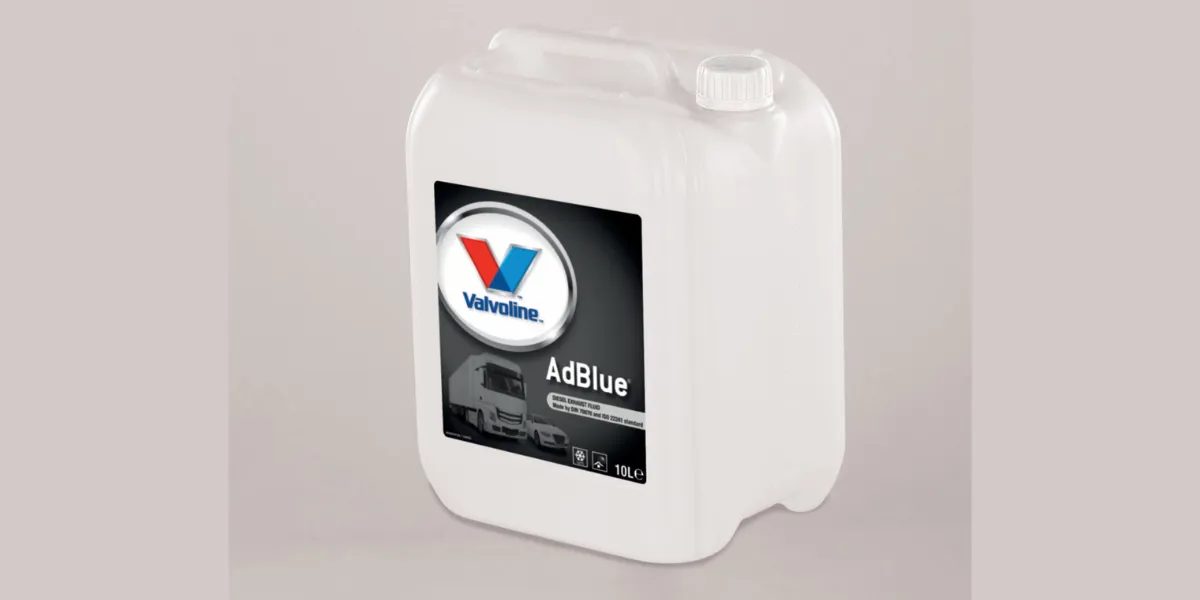
It is worth noting that AdBlue® is a registered trademark — one of several for diesel exhaust fluids — owned by the German Association of the Automotive Industry. As a result, only manufacturers holding a valid license are permitted to sell products under the AdBlue® name. Valvoline is among those authorized producers.
Valvoline AdBlue® is a fully synthetic diesel exhaust fluid formulated from the highest-grade urea available. It is engineered to lower exhaust emissions in vehicles equipped with Selective Catalytic Reduction (SCR) technology. Valvoline's AdBlue® fluid is non-toxic, chemically stable, and clear in appearance, and carries certification from the German Association of the Automotive Industry.
Numerous diesel vehicles incorporate selective catalytic reduction (SCR) technology — an active emissions control system built specifically to reduce nitrogen oxide output.
Inside diesel engines, the combination of oxygen and nitrogen under high-temperature combustion conditions produces nitrogen oxide as a byproduct. When AdBlue® is injected into the hot exhaust stream, it reacts with exhaust gases and triggers the breakdown of harmful mono-nitrogen oxides, converting them into nitrogen (N2) and water (H2O) — substances that pose no threat to the environment or human health.
As noted above, all diesel vehicles registered after 2015 and fitted with SCR technology are required to use a diesel exhaust fluid.
The following is a list of vehicle manufacturers that have adopted AdBlue® compatibility in their lineup:
AdBlue® plays an indispensable role in the operation of modern diesel engines, which is why choosing a high-quality formula — such as Valvoline AdBlue® — is a sound investment.
Topping up the fluid yourself is entirely feasible, provided you review the manufacturer's instructions beforehand. Remember that AdBlue® must never be added to the fuel tank — it goes into its own dedicated reservoir, which manufacturers typically mark with a blue filler cap for easy identification. Tank capacity generally falls between 8 L and 25 L, and consumption varies depending on the vehicle model and driving habits. For Valvoline AdBlue®, consumption is typically around 5% of diesel fuel usage per 100 km.
Of course, a qualified technician can always handle the top-up for you and carry out a thorough inspection of the SCR system at the same time.
For any further questions about AdBlue®, don't hesitate to reach out to us or stop by your nearest Valvoline distributor.
No letters yet — be the first to write.