A brake job affects both your safety and your budget, so understanding brake pad replacement cost is useful before a shop hands you an estimate. Let's start with the basics and build from there. Brake pads are friction components that press against a brake rotor, the flat metal disc attached to the wheel hub. That friction converts the vehicle's motion into heat and slows the car.
For many vehicles, a typical brake pad replacement costs about $150 to $400 per axle, including parts and labor. Luxury vehicles, performance models, trucks, and cars with electronic parking brakes can run from $400 to $800 or more per axle. The word axle matters: a front brake service covers both front wheels, while a rear service covers both rear wheels.
What a Brake Pad Replacement Includes
A standard service usually replaces the pads on one axle, cleans the mounting surfaces, lubricates appropriate contact points, and checks the rotor condition. A reputable technician should also inspect caliper movement, brake hoses, hardware, and the brake fluid level. A caliper is the clamping mechanism that squeezes the pads against the rotor.
The brake pad material comes in several forms. Ceramic pads are often quiet and produce less visible dust, but they can cost more. Semi-metallic pads commonly offer strong heat performance and are widely used on trucks and vehicles that work hard. Organic pads are sometimes less expensive and can be smooth, although their service life and heat tolerance differ by application.
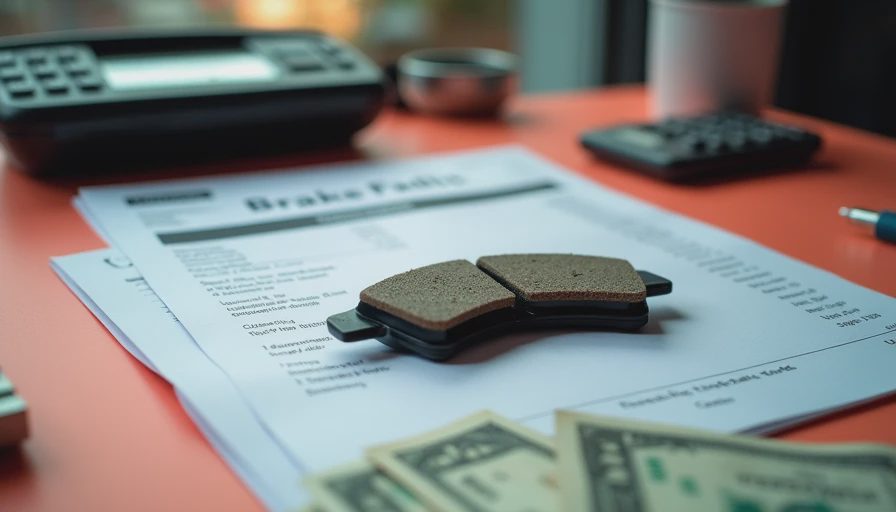
Brake pad replacement cost is not simply the price printed on a parts box. A shop may use economy, premium, or original-equipment-equivalent pads. Economy pads might cost $30 to $70 per axle, while better aftermarket or factory-style sets can cost $80 to $200. Labor commonly adds $100 to $250 per axle, depending on regional rates and vehicle design.
Why Rotors Can Change the Estimate
The rotor provides the surface the pad grips. If it is deeply grooved, cracked, below its minimum thickness, or warped enough to create pedal pulsation, replacement may be safer than installing new pads alone. Rotor replacement can add roughly $150 to $500 per axle, including parts and labor. Some shops resurface rotors, meaning they machine a small amount of metal from the face. That option is not appropriate when the rotor is already too thin or badly damaged.
A practical estimate might look like this: $110 for pads, $180 for labor, and $280 for two new rotors. The total would be about $570 for one axle before tax or shop fees. This is why two estimates for the same vehicle can differ by several hundred dollars without either shop automatically being dishonest.
A technician should measure rotor thickness rather than recommend replacement solely because the pads are worn. Ask for the measured thickness, the manufacturer minimum, and a description of any grooves, heat spots, or cracking. Those details turn a vague sales recommendation into understandable mechanical evidence.
Symptoms That Mean You Should Schedule Service
The most common warning sign is a high-pitched squeal. Many pads include a wear indicator, a small metal tab designed to contact the rotor and create noise before the friction material is completely gone. Grinding is more urgent. It can mean the friction material has been exhausted and the backing plate is contacting the rotor.
Other symptoms include a brake pedal that pulses under moderate braking, a vehicle that pulls to one side, or vibration through the steering wheel. A soft or sinking pedal can involve air, moisture, a hydraulic leak, or another brake-system problem rather than ordinary pad wear. Brake fluid is the hydraulic liquid that transfers pedal force to the calipers, so a low level or leak deserves prompt attention.
Do not judge pad life by mileage alone. A driver who spends time in Atlanta traffic may wear pads faster than someone driving open rural roads. Heavy cargo, steep hills, towing, frequent hard stops, and repeated short trips also change the result. A visual inspection through the wheel spokes can provide a clue, but a technician should inspect the inner and outer pads because they do not always wear evenly.
Comparing Shop Quotes Without Guessing
When comparing brake pad replacement cost, request an itemized estimate. It should identify the axle being serviced, pad brand or grade, rotor condition, labor charge, shop supplies, and warranty. Ask whether the price includes new abutment clips or other hardware. Hardware helps the pads move correctly and can prevent rattles; reusing badly corroded hardware is a false economy.
A dealership may charge more because of higher labor rates and factory-branded parts. Independent repair shops often provide competitive pricing and may offer several pad choices. National chains such as Firestone, Midas, Meineke, and Pep Boys commonly advertise brake specials, but the final invoice can increase if inspection finds worn rotors or seized caliper hardware. Read the complete estimate rather than comparing only the advertised starting price.
If a quote is unusually low, ask what it excludes. A $99 advertised brake service may cover labor or basic pads but not rotors, premium materials, taxes, or difficult electronic procedures. If a quote is unusually high, ask for measurements and a written explanation. Good communication should make the mechanical reasoning clear.

DIY Replacement Versus Professional Service
Replacing pads can be a reasonable project for an experienced home mechanic with jack stands, wheel chocks, a torque wrench, and the correct service information. The vehicle must be supported securely; never rely on a jack alone. The caliper should be supported so its flexible brake hose is not stretched, and wheel lug nuts should be tightened to the vehicle's specified torque.
Modern vehicles add complications. An electronic parking brake may require a service mode or scan tool before rear pads can be removed. Some vehicles use a pad-wear sensor that must be replaced or reset. Incorrectly pushing a caliper piston, contaminating friction surfaces with grease, or failing to pump the pedal before driving can create a serious hazard.
For a first-time owner, professional installation is often the better value. Paying $200 to $400 for accurate work is preferable to damaging a rotor or discovering a soft pedal after an incomplete repair. After service, the pads usually need a bedding procedure: a controlled series of moderate stops that transfers an even layer of material to the rotor. Follow the pad maker's instructions and avoid panic stops during the initial break-in period.
A Simple Decision Process for Your Estimate
Start by identifying whether the quote covers the front axle, rear axle, or all four wheels. Next, ask how much friction material remains and whether the rotors meet thickness specifications. Then compare pad construction, warranty length, labor time, and included hardware. Finally, ask whether the shop found a separate problem such as a leaking caliper, damaged hose, or contaminated brake fluid.
For example, a compact sedan needing front pads only might reasonably land near $250 to $450. A midsize SUV needing pads and rotors on the front axle might reach $450 to $750. A luxury SUV with large rotors, electronic parking brakes, and premium parts can exceed $900 for one axle. These ranges are planning tools, not a substitute for vehicle-specific inspection.
Quick Quiz: If a shop says your pads are worn but the rotors are fine, what should the estimate include? It should identify the axle, pad parts, labor, hardware or clips, taxes or fees, and warranty. If rotor replacement is recommended, you should also receive a clear reason, such as measured thickness below specification or visible damage.
If you remember one concept from this post, make it this one: brake pad replacement cost depends on the complete repair, not just the pad itself. Compare evidence, understand the parts, and choose a shop that explains the work before asking for approval.

No letters yet — be the first to write.