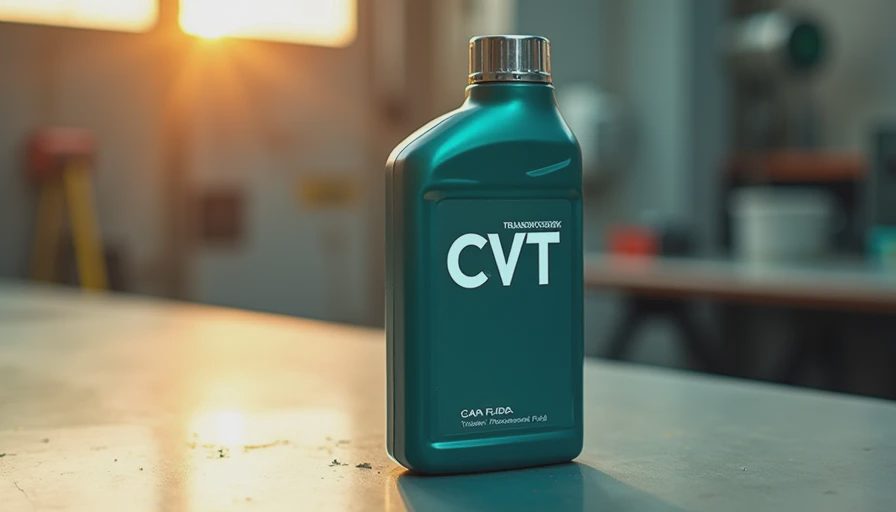
If you own a car with a continuously variable transmission, knowing the right time for a **CVT transmission fluid change** can save you from costly repairs. Let's start with the basics and build from there. CVT fluid is specially formulated to handle the unique demands of a CVT—high friction, heat, and constant belt-to-pulley contact. Using the wrong fluid can lead to slip, shudder, or even transmission failure.
What Is CVT Transmission Fluid and Why Does It Matter?
A CVT uses a steel belt or chain running between two variable-diameter pulleys. Unlike a traditional automatic transmission with fixed gears, the CVT constantly adjusts pulley widths to keep the engine in its most efficient rpm range. The fluid in a CVT does three jobs: lubricates the moving parts, transfers hydraulic pressure to move the pulleys, and cools the belt-to-pulley interface. Over time, heat and friction break down the fluid's additives, reducing its ability to protect and lubricate. A neglected **CVT transmission fluid change** can lead to belt slipping, shuddering on acceleration, and eventual transmission rebuild—easily a $3,000–$5,000 repair.
System Diagram reference: Imagine a V-belt connecting two cones—that’s your CVT. The fluid sits in a separate pan and is circulated by a pump.
When to Change CVT Transmission Fluid
Most carmakers recommend a **CVT transmission fluid change** every 30,000 to 60,000 miles. But the exact interval depends on your driving habits. Severe conditions—stop-and-go traffic, towing, extreme heat, or frequent mountain driving—can cut that interval in half. Check your owner’s manual for the specific recommendation. For example, Nissan often calls for a fluid change every 30,000 miles in severe service, while Honda may stretch to 50,000 miles under normal use. If you’ve never changed it, and you’re past 60,000 miles, do it ASAP—even if the fluid looks clean. Dark, burnt-smelling fluid means the change is overdue.
Quick Quiz: How often should you change CVT fluid under severe driving conditions? (Answer: Every 15,000–30,000 miles, depending on the manufacturer.)
How to Change CVT Transmission Fluid (Step-by-Step)
This procedure is for a simple drain-and-fill, not a full flush. Most manufacturers recommend drain-and-fill every 30,000 miles; a full machine flush is typically only advised if the fluid is severely contaminated or at higher mileages.
- **Gather supplies** – You’ll need the correct CVT fluid (e.g., Honda HCF-2, Nissan NS-3, Subaru CVTF-II), a drain pan, a socket set, a funnel, and a torque wrench. Do not substitute ATF or generic alternatives; CVT fluids are specific.
- **Warm up the transmission** – Drive the car for a few minutes so the fluid circulates and thins out. Park on level ground, then raise and secure the car with jack stands.
- **Drain the old fluid** – Locate the drain plug under the transmission pan (often a 10mm or 14mm bolt). Remove it and let the fluid drain completely. Replace the drain plug washer and tighten to torque spec (typically 25–35 ft-lb).
- **Measure how much came out** – Most CVTs hold 4–7 quarts total, but only about half drains out. Measure the drained volume so you can add the same amount.
- **Add new fluid** – Through the dipstick tube (or fill plug if no dipstick), pour in the exact amount you drained. Start the engine, shift through all gears (P,R,N,D,L) holding each for a few seconds, then recheck the level with the engine running and transmission at normal operating temp. Top off as needed.
If you have a sealed transmission (no dipstick), check the service manual for the temperature-check procedure—it often involves a scan tool to monitor fluid temp.

CVT Fluid Change Cost: DIY vs. Professional
Doing it yourself costs about $60–$120 for the fluid and a few basic tools. If you use a shop, expect $150–$300 for a drain-and-fill. A full flush at a dealer may run $300–$500. The labor is straightforward, so DIY is a great skill to learn. Just be sure to use the exact fluid your car requires. Even a small amount of the wrong fluid can cause shuddering or belt slip.
Quick Quiz: Which costs more—a DIY CVT fluid change or doing nothing until the transmission fails? (Spoiler: A new transmission can cost $3,000–$5,000.)
Quick Quiz: Test Your CVT Fluid Knowledge
- True or false: You can use any ATF in a CVT. (False – always use manufacturer-specified CVT fluid.)
- What is the average recommended interval for a CVT fluid change? (30,000–60,000 miles depending on conditions.)
- What symptom indicates overdue CVT fluid? (Shuddering during acceleration, especially from a stop.)
Common Myths About CVT Transmission Fluid Change
- **Myth: CVT fluid is lifetime fluid.** Reality: “Lifetime” typically means the life of the warranty (100,000 miles). After that, the fluid degrades. Change it.
- **Myth: Flushing is better than drain-and-fill.** Reality: A machine flush can dislodge debris and clog valves if done too aggressively on a high-mileage transmission. Drain-and-fill is gentler.
- **Myth: You can’t check CVT fluid level.** Reality: Many CVTs do have a dipstick, though some are sealed. For sealed units, a dealer scan tool can read fluid temperature to check level.
If you remember one concept from this post, make it this one: **A CVT transmission fluid change is cheap insurance against a very expensive repair.** Stick to the schedule, use the right fluid, and your CVT will reward you with smooth, reliable operation.



No letters yet — be the first to write.