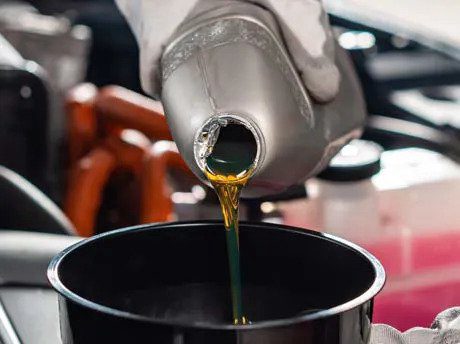
A widespread misconception holds that blending synthetic and mineral oils carries no real penalty. Though it won't destroy your engine on the spot, the combination undermines the strengths of each type. Synthetics such as Valvoline SynPower™ 5W-30 are purpose-built with precision additives and molecular uniformity to deliver extended drain intervals and superior performance. Introducing mineral oil into the mix compromises that thermal stability and cleaning power.
Anyone who works on cars professionally understands that transitioning between oil types requires a full drain and refill—not a casual top-up. Even when staying within the synthetic category, matching the correct specification to your vehicle (ACEA, API, OEM approvals) remains absolutely essential.
Quick tip: If circumstances force you to blend oils temporarily, schedule a full oil change with the appropriate product at the earliest opportunity. You will make it to your destination, and the harm will be limited.
Open the bonnet and spot pink, green, blue, or orange liquid in the coolant reservoir—and it is tempting to treat the colour as a reliable guide. Sadly, that logic falls apart quickly. Coolant makers add dyes for brand identity, not to signal universal compatibility. Two bottles of pink coolant could be entirely incompatible with each other. A single green formula might suit a 1990s hatchback perfectly while wreaking havoc in a modern turbocharged engine.
What truly distinguishes coolants is the chemistry of their corrosion inhibitors. Older formulas rely on inorganic salts (IAT), while contemporary products use organic acids (OAT) or a combination of both (HOAT). These inhibitors protect internal surfaces—aluminium, steel, plastic, and rubber—but they are engineered for their own chemistry, not for blending. When mismatched inhibitors meet, they can react to produce gel-like deposits that clog narrow coolant passages and deprive critical components like the cylinder head of adequate heat transfer. Disregard the colour entirely and go straight to the precise specifications on the label.
Brake fluids occupy distinct categories. DOT 3 and DOT 4 are both glycol-based, making them mixable in a pinch—though far from ideal, since DOT 4 carries a higher boiling point and absorbs moisture differently. DOT 5, however, is an entirely separate formula. Being silicone-based, it is fundamentally incompatible with the others. Combining them can produce a spongy brake pedal, corrosion throughout the braking system, or outright failure.
Valvoline Brake & Clutch Fluid DOT 4 delivers high-temperature stability and suits the majority of contemporary braking systems. Matching the fluid to the manufacturer's specified grade is non-negotiable—never fall into the trap of assuming all DOT fluids are interchangeable.
Important: Wipe the reservoir cap clean before removing it, and never pour fluid from an unsealed or potentially contaminated container. This advice applies specifically here, but it holds true across every fluid service on your vehicle.
Automatic Transmission Fluid (ATF) and Continuously Variable Transmission (CVT) fluid perform fundamentally different jobs, despite their similar appearance. ATF is engineered for stepped gearboxes, generating hydraulic pressure and lubrication through discrete gear ratios. CVT fluid is specially formulated to handle belts or chains operating under continuously shifting loads.
Combining them invites poor gear changes, clutch slippage, and lasting transmission damage. It still happens—particularly when mechanics or owners reach for generic "multi-vehicle" fluids without scrutinising the fine print.
Mechanics' rule of thumb: If the transmission type or required specification is unknown, do not guess. Stick exclusively to OE-approved or application-specific fluids.
Power steering systems tend to get overlooked because they appear straightforward—and for a long time, a splash of spare ATF was enough to keep the pump running. That workaround no longer holds. Modern power steering systems are compact, operate under high pressure, and are increasingly particular about fluid properties. Using an incompatible fluid may not trigger immediate failure, but gradual deterioration in the form of noisy steering, heavy operation, and internal seal damage is a predictable outcome.
The concern extends beyond viscosity. Foam resistance, temperature tolerance, and a precise balance of anti-wear additives all factor in. Certain ATFs perform well in systems specifically designed to accept them. But a large share of European vehicles and newer platforms demand dedicated power steering fluids.
Tip for DIYers: Open the owner's manual first. When it specifies "power steering fluid," that is not an invitation to use whatever red liquid happens to be sitting on the shelf. It means Power Steering Fluid—full stop.
Combining vehicle fluids is far more consequential than a casual chemistry experiment—it is a wager placed against your vehicle's longevity. Even when nothing goes catastrophically wrong in the short term, accelerated wear and compromised system efficiency quietly accumulate as the hidden price. Valvoline's lineup of OEM-approved, application-specific products is built precisely to help both professionals and everyday drivers sidestep these preventable mistakes.
When uncertainty strikes, resist the urge to blend. Drain, flush, and refill with the correct product every single time.



No letters yet — be the first to write.