A cooling-system mistake can turn a routine fluid check into a $1,500 radiator or engine repair. OAT coolant is one of the most common modern formulas, but the label alone does not tell you whether it belongs in your vehicle. Let's start with the basics and build from there. Once you understand the chemistry, color limits, mixing risks, and service procedure, you can make a sound decision instead of choosing fluid by bottle color.
Coolant is a mixture of antifreeze and water that carries heat away from the engine. Antifreeze lowers the freezing point and raises the boiling point, while additives protect metal surfaces from corrosion. OAT coolant uses organic acid technology, meaning its corrosion inhibitors are carbon-based compounds designed to protect aluminum, iron, steel, and other cooling-system materials over longer service intervals.
What OAT coolant does inside the engine
When an engine runs, combustion creates more heat than the radiator can remove through air alone. A water pump circulates coolant through passages in the engine block and cylinder head. The hot fluid then travels to the radiator, where air removes heat before the fluid returns to the engine. The thermostat controls when and how much fluid enters that circuit.
OAT coolant does not coat every internal surface with a thick, continuous layer. Instead, its inhibitors generally react more selectively at corrosion sites. That approach reduces additive depletion and helps modern systems operate for extended intervals. Many OAT formulas are intended for roughly five years or 100,000 to 150,000 miles when installed correctly, although the vehicle manufacturer sets the actual schedule.
The practical benefit is not just fewer fluid changes. Correct chemistry helps protect narrow radiator passages, water-pump seals, heater cores, and aluminum components. A neglected system can develop rust, scale, or sludge that restricts flow and causes an overheating event. A tow, head-gasket repair, or warped cylinder head can cost hundreds or several thousand dollars, while the right coolant and a proper inspection are comparatively inexpensive.
OAT, IAT, and HOAT: do not shop by color
IAT means inorganic additive technology. This older chemistry commonly uses silicates or phosphates and often requires more frequent replacement. HOAT means hybrid organic acid technology; it combines organic inhibitors with selected inorganic additives. OAT coolant relies primarily on organic inhibitors, but formulas differ among manufacturers and applications.
Color is an unreliable identification method. Orange, red, pink, yellow, and even blue products can represent different chemistries, and manufacturers sometimes change dye colors without changing the vehicle specification. Read the owner manual, radiator-cap label, service information, or the coolant maker's compatibility chart. A product labeled universal is not automatically the best choice for every engine.
Quick Quiz: If two bottles have the same color, are they guaranteed to be chemically compatible? No. Color is dye, not a complete specification. The correct answer comes from the required standard and formulation.
Can you mix OAT coolant with another formula?
Mixing a small amount of the wrong coolant will not always cause an immediate failure, but that does not make it a good maintenance strategy. Different inhibitor packages can reduce corrosion protection, create deposits, or produce an unclear mixture that no longer meets the vehicle maker's requirements. Some combinations are specifically discouraged because silicate, phosphate, or organic additives can behave poorly together.
If the expansion tank is slightly low, use the exact premixed product specified for the vehicle when possible. In an emergency, distilled water can temporarily restore the level, but it changes freeze and boil protection. Do not open a hot radiator cap; pressurized coolant can cause severe burns. Afterward, restore the correct mixture and inspect for a leak.
For a vehicle with unknown fluid history, a drain-and-fill may not remove all incompatible material. A complete flush with the proper procedure is safer. The technician should capture the old fluid, refill with the specified mixture, run the engine until the thermostat opens, bleed trapped air, and recheck the level after a full cool-down.
How to choose the right product
Start with the vehicle year, make, model, engine, and service requirement. A 2018 Ford Explorer, a 2020 Toyota Camry, and a 2016 Chevrolet Silverado may all use long-life coolant, but their approved specifications are not interchangeable simply because the bottles look similar. Some products are sold as concentrate, while others are premixed at about 50 percent antifreeze and 50 percent deionized water.
Concentrate can be economical when you need several gallons, but it must be mixed accurately. In most U.S. climates, a 50/50 mixture provides a useful balance of freeze protection and heat transfer. Too much antifreeze can actually transfer heat less effectively than the intended mixture. Tap water is a poor long-term choice in areas with hard water because minerals can contribute to deposits.
Major brands such as Valvoline, Prestone, Peak, and Zerex offer multiple coolant families. Choose by the listed vehicle specification, not by brand loyalty or the lowest shelf price. A $15 gallon of incompatible fluid is not a bargain if it contributes to a $300 flush or a much larger cooling-system repair.
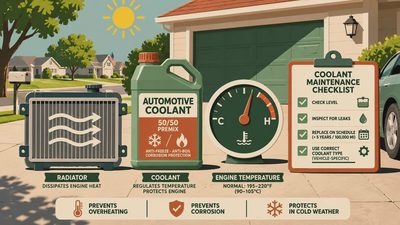
System Diagram reference: Trace the route from the radiator to the thermostat, engine passages, heater core, and recovery tank. This simple loop explains why air pockets and restricted flow can affect both cabin heat and engine temperature.
Service clues and warning signs
Inspect the coolant reservoir only when the engine is cold. The level should sit between the marked minimum and maximum lines. Look for wet areas around hose connections, the radiator seams, water pump, thermostat housing, and reservoir. A sweet smell, white or colored crust, repeated low level, or visible puddle indicates a leak that new fluid will not fix.
Cloudy fluid, floating particles, an oily film, or thick sludge deserves attention. Rust-colored coolant can indicate depleted protection or contamination. A temperature gauge that rises above normal, a heater that blows cold air, bubbling in the reservoir, or a warning light can signal low coolant, trapped air, a failed thermostat, or a more serious engine problem. Stop driving if the gauge enters the hot zone.
Never pour coolant on the ground. Ethylene glycol is poisonous to people and animals, and even a small spill can be dangerous. Store sealed containers securely and take used fluid to a recycling or hazardous-waste collection point. Keep the cap and original label if you need to identify what was installed.
A simple maintenance plan
Record the date, mileage, brand, specification, and mixture after every service. At each oil change, check the cold reservoir level and inspect the visible hoses. Follow the manual for replacement intervals rather than resetting the schedule because the fluid still looks bright. A test strip or refractometer can estimate freeze protection, but it cannot prove that the additive package is still healthy or compatible.
If you are buying a used vehicle, ask for cooling-system records. No records means the safest plan is often a documented inspection and, if needed, a complete service using the specified OAT coolant. That gives you a known starting point instead of guessing from color or an unknown label.
Quick Quiz: What is the most important selection rule? Match the vehicle's required specification first, then choose a reputable product and the correct concentration. If you remember one concept from this post, make it this one: OAT coolant is a chemistry choice, not a color choice.
When you are ready to service the system, compare the manual's specification with the bottle, prepare a drain pan and distilled water, and allow the engine to cool completely. If the system shows sludge, persistent leaks, or overheating, pay for a professional diagnosis before refilling. A careful decision today protects the radiator, water pump, heater core, and engine from avoidable damage.


No letters yet — be the first to write.