Putting the wrong fluid in an automatic transmission can turn a routine service into an expensive repair. ATF+4 transmission fluid is the specified fluid for many Chrysler, Dodge, Jeep, and Ram applications, but the vehicle's service information—not the badge alone—determines whether it belongs in yours. Use a product licensed to the ATF+4 specification when your manufacturer calls for ATF+4. Let's start with the basics and build from there.
What the fluid actually does
An automatic transmission uses fluid for several jobs at once. It lubricates moving parts, carries heat away, and transfers hydraulic pressure. Hydraulic pressure is force created by pressurized liquid; the transmission uses it to apply internal clutches, which connect and disconnect rotating components to change gears.
ATF+4 transmission fluid also has carefully controlled friction properties. Friction is the resistance between contacting surfaces. Inside a transmission clutch, the fluid has to let surfaces engage in a controlled way rather than grab abruptly or slip excessively. That behavior is part of how the transmission achieves smooth, consistent shifts.
System Diagram reference: Picture a loop from the transmission pan to the pump, through control passages and clutches, then through the cooler and back. The pump moves fluid; the control system directs its pressure; the cooler helps remove heat. Exact layouts vary by transmission.
The fluid's base oil provides much of its lubricating foundation. Additives are ingredients blended into that oil to manage friction, resist oxidation, and address other operating demands. Oxidation is a chemical reaction with oxygen that can gradually degrade fluid, especially under heat.
How to tell whether your vehicle needs it
Start with the owner's manual's fluids section. Match the specification to the exact transmission and, where applicable, the model year and engine. A single vehicle line can have different transmissions, so a recommendation for one version does not automatically apply to another. If the manual is missing or unclear, a dealer parts department can check the vehicle identification number, or VIN, against its service information.
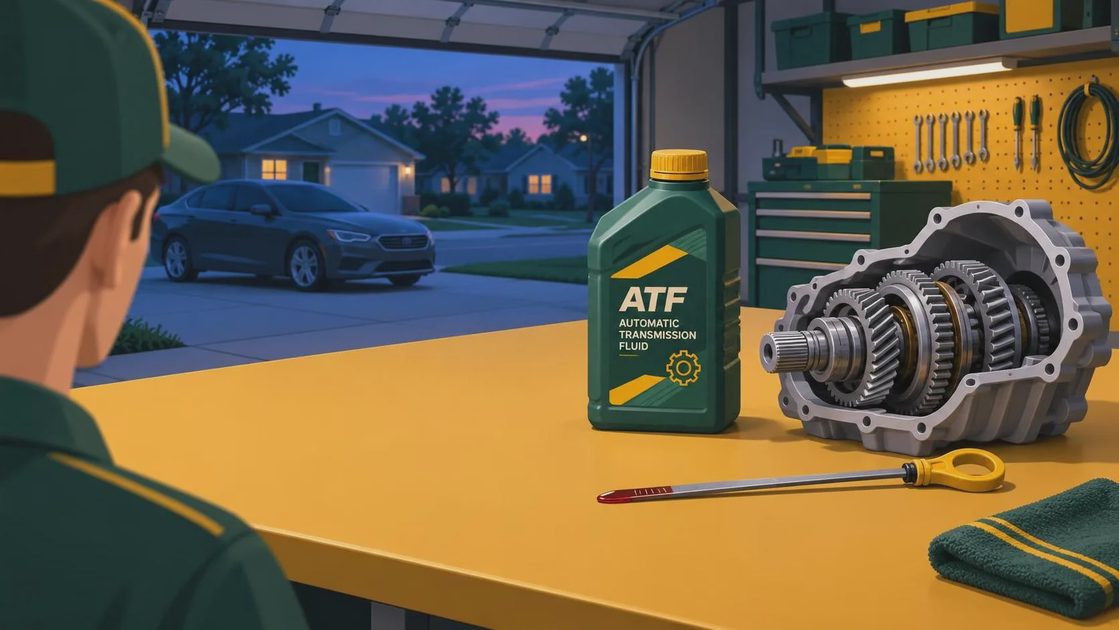
If the manual calls for ATF+4 transmission fluid, look for the ATF+4 licensing information on the container. The Center for Quality Assurance maintains a licensed-products list for the specification; use that list and the bottle's labeling to check a product before buying. A claim that a fluid is merely "suitable for" an application is not the same thing as an ATF+4 license.
Do not select fluid by color. Red dye makes many automatic transmission fluids easier to identify, but it does not establish their chemistry or compatibility. Likewise, a bottle labeled for a Chrysler vehicle is not necessarily correct for every Chrysler transmission. The specification is the important part.
Some transfer cases and power steering systems also call for ATF+4, but others require different fluids. A transfer case distributes power between axles in a four-wheel-drive or all-wheel-drive vehicle. Check the requirement for each component separately; transmission fluid and transfer-case fluid are not interchangeable simply because both containers say ATF.
Can you mix it with another fluid?
The safest rule is to use the specified fluid for topping off and servicing. ATF+4 transmission fluid is not a universal replacement for every automatic transmission fluid, and a universal fluid should not be assumed to meet ATF+4 requirements without the appropriate license. Fluids that look alike can behave differently when clutches engage.
ATF+4 is generally specified as a replacement for earlier Chrysler ATF+3, ATF+2, and ATF+ fluids in many applications, but there are application exceptions. Check the manufacturer's service information for the particular vehicle before substituting it for an older specification. Do not use that backward-compatibility rule to justify putting it in a transmission that calls for a different modern fluid.
If a small amount of the wrong fluid has already gone in, avoid adding more and consult a qualified transmission shop or the manufacturer before driving. Tell them the vehicle, transmission if known, fluid added, and approximate amount. The appropriate response depends on the mixture and the unit; a drain and refill may not remove all fluid from the cooler and torque converter. The torque converter is the fluid coupling between the engine and transmission.
Check level and plan service correctly
Follow the vehicle-specific procedure for checking ATF+4 transmission fluid. Some transmissions have a dipstick; others require a specified fluid temperature, a level plug, or a service tool. The instructions may also specify whether the engine runs and which gear positions to select. An incorrect procedure can make a properly filled transmission appear low—or hide an overfill.

Park on level ground and secure the vehicle as the procedure directs. Never crawl under a vehicle supported only by a jack. If the level check requires lifting the vehicle, reading temperature data, or working near hot or moving parts, a properly equipped shop is a sensible choice.
Low fluid deserves a leak inspection, not just repeated top-offs. Look for wetness around the pan, cooler lines, and seals, but remember that fluid can travel before it drips. Burning smells, delayed engagement, or slipping also warrant diagnosis; fresh fluid alone may not fix an existing mechanical problem.
Use the manufacturer's maintenance schedule for your driving conditions. Towing, frequent stop-and-go trips, and sustained heat may put a vehicle into a severe-service schedule, but the manual defines the applicable conditions and interval. There is no single mileage number that fits every transmission.
A drain and refill replaces only the fluid that comes out during that procedure. Some remains inside the transmission and associated components. Ask a shop what its proposed service includes, whether the filter is serviceable, and exactly which fluid it will use. If the unit needs ATF+4 transmission fluid, that specification should appear on the work order.
Quick Quiz: Check your understanding
- A fluid is red. Does that prove it meets the required specification? No. Color is not a reliable compatibility test; read the specification and licensing information.
- Why does friction behavior matter? Internal clutches need controlled engagement. A fluid with different friction characteristics can affect how those clutches apply.
- Your transmission is low again shortly after a top-off. What comes next? Investigate the cause, including possible leaks, rather than treating repeated top-offs as maintenance.
If you remember one concept from this post, make it this one: the right fluid is defined by the transmission's required specification, not by the color in the bottle or the name on the vehicle's grille.
No letters yet — be the first to write.