Choosing the best coolant brand 2026 can protect your engine from overheating, corrosion, and expensive cooling-system repairs. The important lesson, however, is that a familiar logo does not automatically make a coolant correct for your vehicle. Coolant is a chemical working fluid, and its additive package must match the materials and requirements inside your radiator, water pump, hoses, and engine passages.
I teach car-care workshops in Atlanta, and I often see drivers compare only the price of a gallon jug. That is like choosing motor oil by color. Let's start with the basics and build from there. The correct coolant is the product that meets your vehicle manufacturer's specification, works at the required concentration, and is installed without contamination.
What coolant actually does
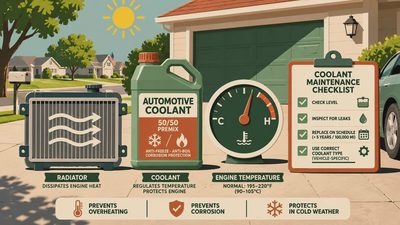
Engine coolant is a mixture of antifreeze concentrate and water. Antifreeze lowers the freezing point and raises the boiling point, while the water transfers heat efficiently. Most passenger vehicles use a 50/50 mixture, although the owner's manual may specify another ratio for unusual climates or applications. In the United States, premixed 50/50 coolant is convenient because it is ready to pour.
Coolant also contains corrosion inhibitors. These chemicals protect aluminum cylinder heads, cast-iron blocks, copper components, solder joints, and the water pump from electrochemical damage. Over time, inhibitors become depleted. The fluid can still look colorful while offering less protection, so appearance alone cannot determine service condition.
A coolant system under pressure operates above water's normal boiling point. The radiator cap controls that pressure, and the cooling fan moves air through the radiator when vehicle speed is low. If the fluid is wrong, weak, contaminated, or too low, the system loses its ability to control heat. A single overheating event can damage a head gasket or warp an aluminum cylinder head, turning a $30 fluid service into a repair costing well over $1,000.
System Diagram reference: Picture the route as a closed loop: water pump, engine passages, thermostat, radiator, and reservoir. The thermostat regulates flow; it does not cool the fluid by itself.
Compare coolant chemistry before comparing brands
The best coolant brand 2026 depends more on chemistry and approval language than on advertising. Inorganic additive technology, or IAT, is the older conventional formulation often associated with green coolant and shorter replacement intervals. Organic acid technology, or OAT, uses organic corrosion inhibitors and is common in many newer vehicles. Hybrid organic acid technology, or HOAT, combines organic inhibitors with selected inorganic additives.
Color is not a reliable chemistry guide. Manufacturers use different dyes, and two fluids with the same color can have different additive packages. Likewise, universal coolant is not automatically universal in the sense of being ideal for every car. Read the back label for explicit compatibility and specification claims, then compare that information with the owner's manual.
Brands such as Zerex, Peak, Prestone, and Valvoline offer multiple formulas rather than one product that fits every application. Zerex lines often make vehicle-specific requirements easy to identify. Peak provides both conventional and extended-life options. Prestone sells widely available universal and vehicle-specific products. Valvoline's Zerex products are especially common in parts stores and repair shops. These are useful starting points, not permission to ignore the specification.
Quick Quiz: If two coolants have the same color, are they automatically compatible? No. Color is dye, not proof of chemistry or approval.
How to identify the correct product
Start with the vehicle identification number, commonly called the VIN, and the owner's manual. The manual may name a coolant standard, a specific technology, or a manufacturer part number. If the manual is missing, an automaker service-information source or a reputable parts catalog can help confirm the application. Record the model year, engine size, and whether the vehicle has a turbocharger, hybrid system, or diesel engine.
Then inspect the label. Look for language such as meets or exceeds a stated manufacturer specification, not simply all makes and models. Also check whether the container is concentrate or prediluted. Concentrate must be mixed with distilled or deionized water. Tap water can introduce minerals that encourage deposits, especially when used repeatedly in a cooling system.
Before opening the cooling system, let the engine cool completely. A hot radiator can release pressurized steam and cause severe burns. Check the reservoir level on level ground, inspect for wet spots around hoses and the water pump, and never use coolant to mask a leak. A low level usually indicates loss somewhere in the system, not normal consumption.
Mixing, flushing, and topping off safely
The safest top-off fluid is the same approved formula already in the system. If you do not know what is installed, adding a random universal product creates uncertainty. A small emergency addition of water can help prevent immediate overheating, but the system should then receive the correct mixture as soon as possible.
A flush is more than draining the reservoir. A proper service removes old coolant from the radiator and engine passages, replaces or safely disposes of the old fluid, and refills the system while removing trapped air. Some vehicles require a specific bleeding procedure because an air pocket can prevent circulation and create local hot spots. Follow the service procedure rather than assuming every radiator fills the same way.
Never mix coolant with windshield washer fluid, brake fluid, or automatic transmission fluid. Keep unused antifreeze away from children and pets because ethylene glycol is poisonous and can taste appealing to animals. Collect drained coolant in a sealed container and use a local recycling or hazardous-waste program.

What a reasonable buying decision looks like
Suppose a 2018 sedan calls for an OAT coolant meeting a named manufacturer standard. A gallon of the correct premix might cost roughly $15 to $30, while concentrate may cost less per finished gallon after dilution. A bargain bottle that lacks the required specification is not a bargain if it contributes to corrosion or a water-pump failure.
For an older vehicle using conventional IAT coolant, a matching conventional product can be sensible. For a newer vehicle requiring HOAT, select a HOAT formula with the correct approval language, even if a cheaper green product is sitting beside it. In each case, the best coolant brand 2026 is the one that satisfies the specification and is available through a trustworthy retailer.
Keep the receipt and write the date, mileage, brand, formula, and mixture on a service card. This small record prevents the next owner, family member, or repair shop from guessing. If the coolant is rusty, oily, sludgy, or repeatedly disappearing, stop comparing brands and diagnose the system first.
Final recommendation and knowledge check
My practical recommendation is to buy a reputable product from Zerex, Peak, Prestone, or another established supplier only after confirming the required chemistry and specification. Do not select based on color, a universal claim, or the lowest shelf price. The best coolant brand 2026 is a compatibility decision, not a popularity contest.
If you remember one concept from this post, make it this one: coolant protects an engine through its chemistry, concentration, and circulation. The label, manual, and service history together tell you more than the bottle color.
Quick Quiz: What should you verify before pouring? First, identify the vehicle and engine. Second, confirm the required coolant technology or manufacturer specification. Third, check whether the fluid is concentrate or premixed. Finally, inspect for leaks and refill only when the engine is cool.
System Diagram reference: Follow the complete loop from reservoir to water pump, engine, thermostat, radiator, and back again. If the level drops after service, the loop needs inspection rather than repeated topping off.
For a routine replacement, gather the correct coolant, distilled water if needed, gloves, a drain pan, and the service instructions before beginning. A careful half-hour of research can prevent hours of repair work and protect the engine you depend on every day.


No letters yet — be the first to write.